<?xml version="1.0" encoding="utf-8"?><feed xmlns="http://www.w3.org/2005/Atom" ><generator uri="https://jekyllrb.com/" version="3.10.0">Jekyll</generator><link href="https://flowquest.net/feed.xml" rel="self" type="application/atom+xml" /><link href="https://flowquest.net/" rel="alternate" type="text/html" /><updated>2026-08-18T11:07:04+00:00</updated><id>https://flowquest.net/feed.xml</id><title type="html">Flowquest</title><subtitle>All available resources for Flows for APEX Enterprise Edition in one place, designed to help you get started and learn more about the product.</subtitle><entry><title type="html">Flows for APEX 26.1: adaptive workflow and AI-driven BPMN agents</title><link href="https://flowquest.net/posts/release26.1/" rel="alternate" type="text/html" title="Flows for APEX 26.1: adaptive workflow and AI-driven BPMN agents" /><published>2026-04-14T00:00:00+00:00</published><updated>2026-04-14T11:00:00+00:00</updated><id>https://flowquest.net/posts/release26.1</id><content type="html" xml:base="https://flowquest.net/posts/release26.1/"><![CDATA[<p>We are excited to start sharing what is coming in <strong>Flows for APEX v26.1</strong>.</p>

<p>This release wave focuses on adaptive workflow automation: supporting knowledge workers, introducing AI-driven adhoc subprocesses and BPMN-defined agents, improving long-running execution, and making workflow apps faster to build.</p>

<h2 id="what-stands-out-in-261">What stands out in 26.1</h2>

<h3 id="adhoc-sub-processes-for-knowledge-workers">Adhoc Sub Processes for Knowledge Workers</h3>

<p>Many real-world processes do not always follow one fixed next step.  v26.1 introduces adhoc sub processes that allow the next activity to be selected at runtime while BPMN still provides the governance, visibility, and completion rules.</p>

<h3 id="ai-driven-adhoc-sub-processes-and-bpmn-agents">AI-Driven Adhoc Sub Processes and BPMN Agents</h3>

<p>v26.1 extends this model with AI-driven control modes.  AI can recommend the next-best action, support hybrid human-plus-AI operation, or act as a fully autonomous BPMN-defined agent inside the process boundaries set by your model.</p>

<h3 id="async-workflow-execution-for-long-running-work">Async Workflow Execution for Long-Running Work</h3>

<p>Selected work can run asynchronously in the background, improving resilience and user experience for long-running service calls, external integrations, and AI-based processing.</p>

<h3 id="better-user-and-developer-experience">Better User and Developer Experience</h3>

<p>The 26.1 cycle also brings practical enhancements for both builders and end users:</p>

<ul>
  <li>task subjects for clearer human task usability</li>
  <li>task parameters for cleaner step inputs and outputs</li>
  <li>JSONPath variable expressions for easier access to structured data</li>
  <li>UserTask Autoform and Start Event Autoform (currently under development)</li>
</ul>

<p>Flows for APEX Enterprise Edition continues to build on the open-source Community Edition with additional advanced features plus product support from Flowquest.</p>

<p><a href="https://flowquest.net/Flows4APEX261Features/">Learn more about the 26.1 highlights</a></p>

<p><a href="mailto:info@flowquest.net">Contact Flowquest</a></p>

<p><a href="https://cal.com/rallen2010/15min">Arrange an exploratory discussion via Zoom</a></p>]]></content><author><name>Richard Allen</name></author><category term="Announcement" /><category term="26.1" /><category term="Enterprise Edition" /><category term="Preview" /><summary type="html"><![CDATA[We are excited to start sharing what is coming in Flows for APEX v26.1.]]></summary></entry><entry><title type="html">Flows for APEX 25.1 release announcement</title><link href="https://flowquest.net/posts/release25.1/" rel="alternate" type="text/html" title="Flows for APEX 25.1 release announcement" /><published>2025-09-23T00:00:00+00:00</published><updated>2025-09-23T10:30:00+00:00</updated><id>https://flowquest.net/posts/release25.1</id><content type="html" xml:base="https://flowquest.net/posts/release25.1/"><![CDATA[<p>We are excited today to fully release  <strong>Flows for APEX v25.1</strong>, packed with exciting new features for both the <strong>Community Edition</strong> and <strong>Enterprise Edition</strong>.<br />
Both editions are now fully available, and existing users are now able to migrate their systems from 24.1 to 25.1.</p>

<h2 id="key-features-in-251">Key Features in 25.1</h2>

<h3 id="1-ai-service-task">1. AI Service Task</h3>

<p>Add AI-powered decisioning and generative tasks into business processes with simple, configurable service tasks.</p>

<ul>
  <li>Drive process. Routing with AI-based decision support outputs</li>
  <li>Generate summers, reports, personalized communications automatically</li>
  <li>Evolve your business processes to add GenAI steps within the framework of your existing processes</li>
  <li>Low code design of APEX  makes AI use simple and repeatable.</li>
</ul>

<h3 id="2-process-suspend-resume-and-rewind">2. Process Suspend, Resume, and Rewind*</h3>

<p>Gain precise control over long-running workflows by suspending, resuming, or rewinding processes at any step without losing state or context.</p>

<ul>
  <li>Suspend process instances safely for investigation or waiting events.</li>
  <li>Resume execution exactly where the process previously stopped.</li>
  <li>Rewind selected steps for correction or re-execution when required.</li>
  <li>Improve resilience and reliability of complex, long-lived workflows.</li>
</ul>

<p>Available in the <a href="https://flowquest.net/" target="_blank">Enterprise Edition</a>.</p>

<h3 id="3-enhanced-apex-human-task-integration">3. Enhanced APEX Human Task Integration</h3>

<p>Enhanced integration with APEX Human Tasks (Approval and Action Tasks)</p>
<ul>
  <li>Support task owner and administrator assignment from the controlling workflow.</li>
  <li>New plugin for declarative return of task state and outcome.</li>
  <li>Better removal and cleanup of cancelled or expired tasks.</li>
  <li>Integration of task definition and state into the Flows for APEX monitor.</li>
</ul>

<h3 id="4-message-queueing-for-process-isolation">4. Message Queueing for Process Isolation*</h3>

<p>Inter process communication using BPMN Message Flow in the Enterprise Edition now uses Oracle Advanced Queueing to decouple sending and receiving processes, increasing reliability when a process is suspended or a participant is offline.</p>

<h3 id="5-enhancements-to-event-logging">5. Enhancements to Event Logging</h3>

<p>Gain clearer visibility into workflow execution with flexible, fine-grained event logging, improving both audit readiness and developer debugging capabilities:</p>

<ul>
  <li>Now captures fine-grained step-level processing events.</li>
  <li>Flexible logging levels at system, diagram, or process instance.</li>
  <li>Highlight instances and steps executed with admin intervention.</li>
  <li>Improved control of log archiving and purging automations.</li>
  <li>Flexible logging meets monitoring, forensic audit, and debugging needs.</li>
</ul>

<h3 id="6-other-developer-features">6. Other Developer Features</h3>

<p>New developer-focused enhancements streamline modeling, improve error handling, and provide clearer visual cues for easier design and maintenance:</p>

<ul>
  <li>Script Task Error Boundary Events let PL/SQL throw BPMN errors.</li>
  <li>Model-defined process naming simplifies deployment and version management.</li>
  <li>Diagram badges highlight metadata directly within process diagrams.</li>
  <li>Updated Flow Viewer plugin built on web component architecture.</li>
  <li>Bundling plugins delivered as APEX Component Groups.</li>
</ul>

<h2 id="editions">Editions</h2>
<p>The <strong>Flows for APEX Community Edition</strong> remains 100% open source under the MIT license, with community support via GitHub.  The <strong>Flows for APEX Enterprise Edition</strong> includes product support and can be licensed from <a href="https://flowquest.net/">Flowquest</a>.</p>

<p>Explore the full details of version 25.1 and start transforming your workflows today!</p>

<p><em>Some features marked with an asterisk (*) are exclusive to the Enterprise Edition.</em></p>

<p><a href="https://flowsforapex.org/Flows4APEX251Features/">Learn more about the release</a>
<br /><a href="https://flowquest.net">Learn more about the Enterprise Edition</a></p>]]></content><author><name>Richard Allen</name></author><category term="Announcement" /><category term="25.1" /><category term="Enterprise Edition" /><category term="Community Edition" /><summary type="html"><![CDATA[We are excited today to fully release Flows for APEX v25.1, packed with exciting new features for both the Community Edition and Enterprise Edition. Both editions are now fully available, and existing users are now able to migrate their systems from 24.1 to 25.1.]]></summary></entry><entry><title type="html">GenAI can help you with BPMN!</title><link href="https://flowquest.net/posts/genai-helps-bpmn/" rel="alternate" type="text/html" title="GenAI can help you with BPMN!" /><published>2024-11-17T00:00:00+00:00</published><updated>2024-11-17T12:00:00+00:00</updated><id>https://flowquest.net/posts/genai-helping-you-with-bpmn</id><content type="html" xml:base="https://flowquest.net/posts/genai-helps-bpmn/"><![CDATA[<h3 id="how-were-using-genai-in-flows-for-apex-to-help-model-business-processes">How we’re using GenAI in Flows for APEX to help model business processes.</h3>

<p>Flows for APEX uses the industry standard process modelling notation, BPMN 2.0, to graphically model business processes. Steps in those processes that require user input or processing can then be rapidly developed using Oracle APEX, and Flows for APEX will then execute and manage instances of those processes. So how can GenAI help us with that?</p>

<p>Business Process Model and Notation (BPMN) representations of a business process appear to the user as a process diagram, showing tasks, events, and gateways that control the process direction. Optionally these diagrams can contain swim lanes showing who (person or organisation) is responsible for each process step, and can show how a process interacts with other processes and/or other organizations.</p>

<p>Under the covers, these BPMN diagrams are stored as an XML document, containing two main sections - one defining the process logic, and a second defining the diagram layout.</p>

<p>Current Gen AI models are good at understanding XML documents, have been trained on material including the BPMN standard, the many books written about BPMN, and the countless number of conference papers written by business consultants over the last two decades. The good news is that you don’t have to stay awake reading all of them - Gen AI has already read them and can help us!</p>

<h2 id="what-can-gen-ai-do-with-a-bpmn-diagram">What can Gen AI do with a BPMN Diagram?</h2>

<ol>
  <li>
    <h3 id="explaining-diagrams">Explaining Diagrams</h3>

    <p>The first thing that GenAI can do is to explain the diagram to us in business English. Or any other language, but I’ll come back to that later!</p>

    <p>The AI models are good at converting the structure and text contained in the BPMN model to a good, well-structured explanation of the process in a diagram. They seem to be good at inferring background purpose and concepts in a model, and describing them - at a high level, or in as much detail as you want.</p>

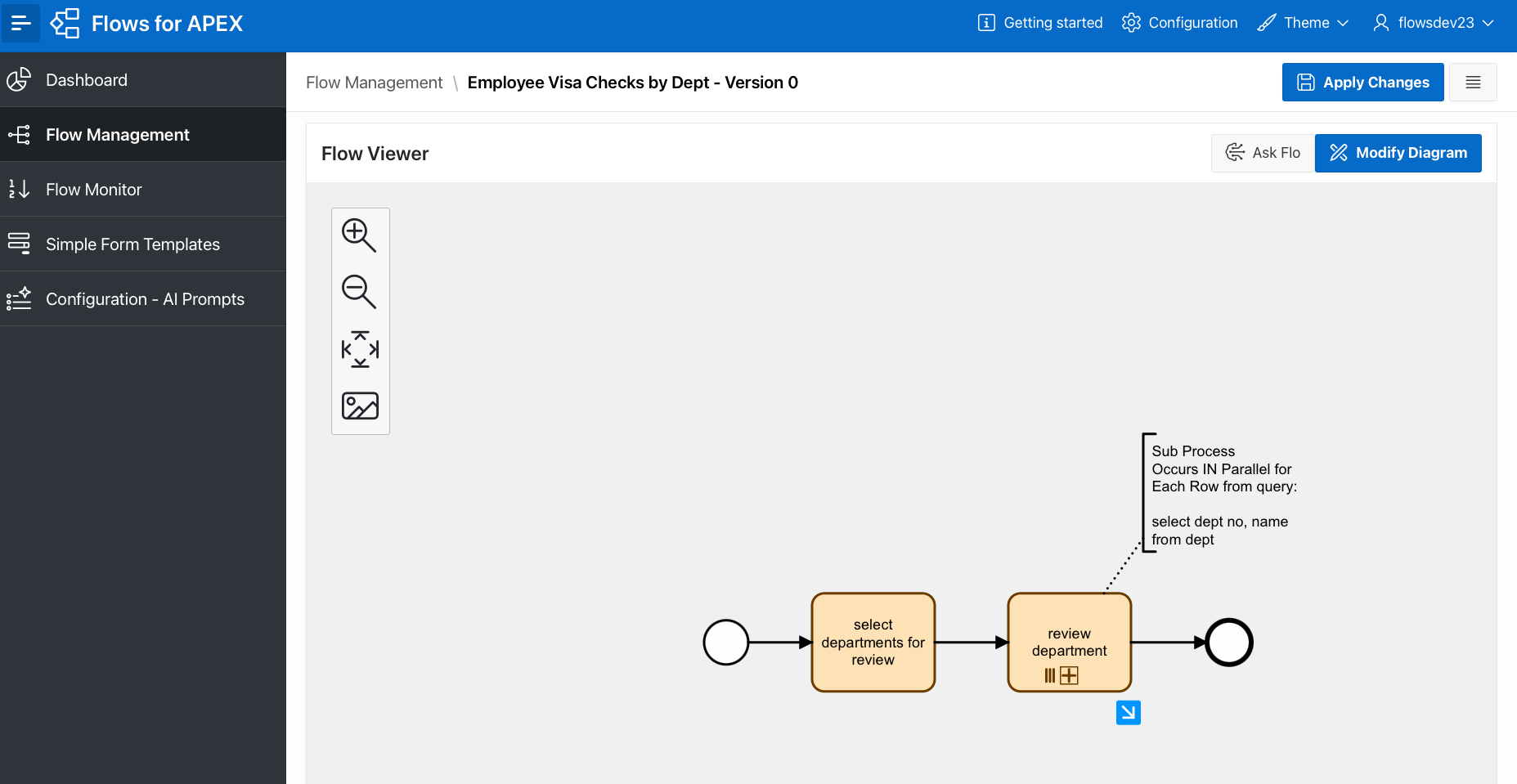
    <p>Let’s take an example. I have a contrived business process built for a demo that conducts annual employment verification checks for staff. The process is started by HR, and then carried out by HR and line managers. Here’s the top level diagram …</p>

    <p><img src="https://flowquest.net/assets/images/ai-blog-visa-proc-l1.png" alt="Employee Check Process - Top level" title="Employee Check Process - Top level" /></p>

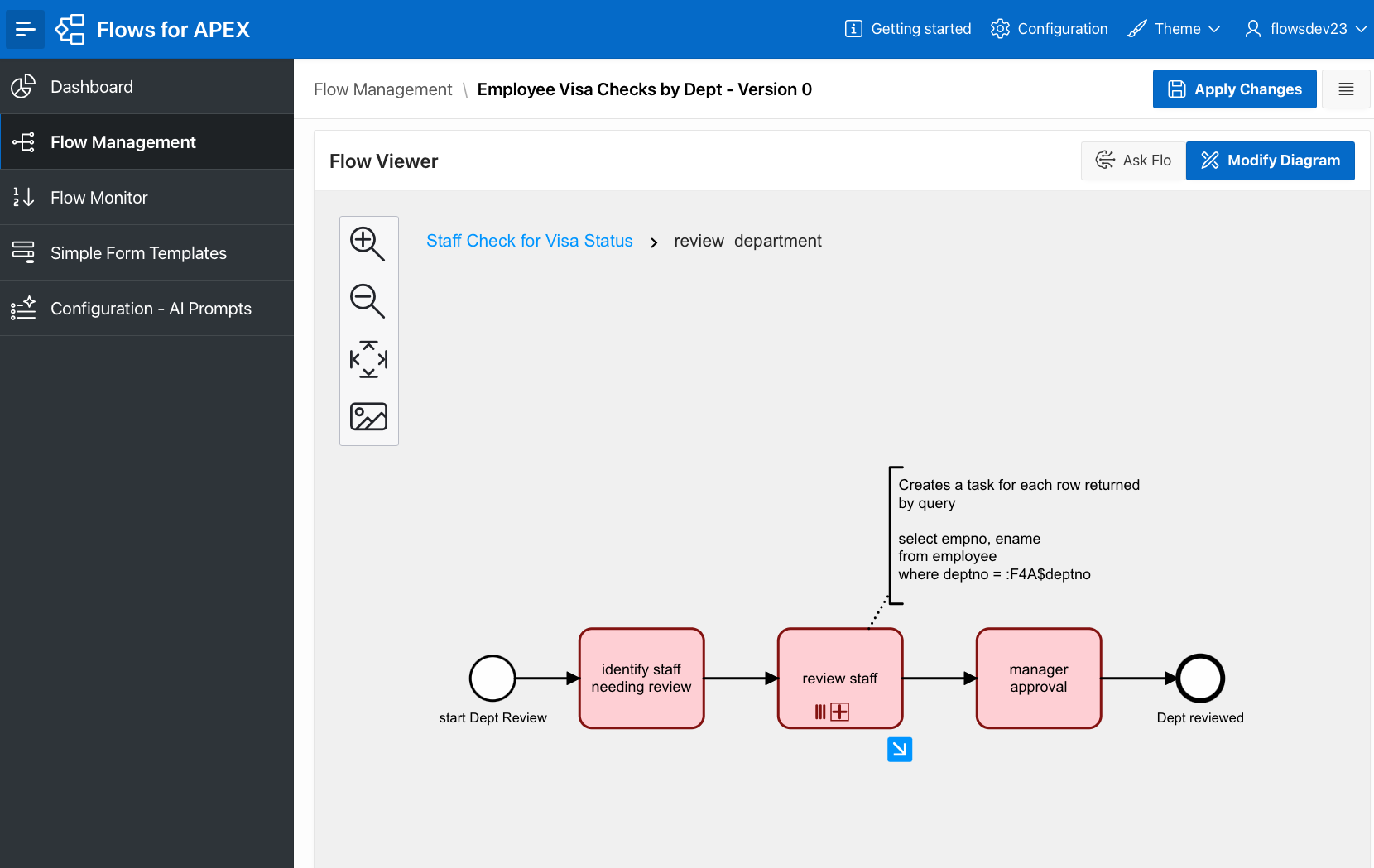
    <p>This diagram uses a subprocess for the ‘review department’ task. If I click on the blue arrow icon underneath ‘review department’, I can see the detail of this subprocess…</p>

    <p><img src="https://flowquest.net/assets/images/ai-blog-visa-proc-l2.png" alt="Employee Check Process - Second level" title="Employee Check Process - Second level" /></p>

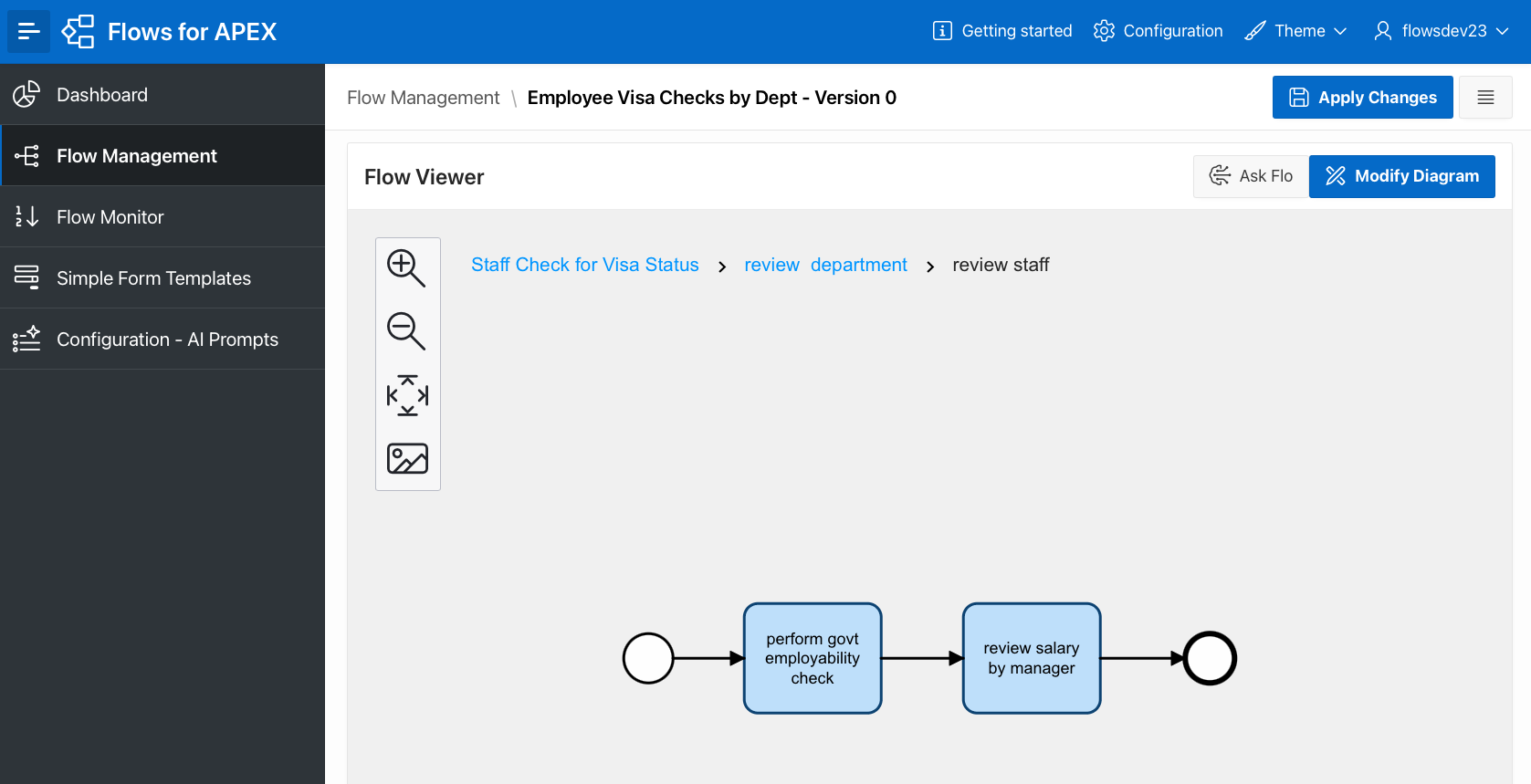
    <p>And so I can see that the process for each department is to identify staff needing a review, that conduct that review — the details of which are contained in a sub process, which again I can see by clicking on the blue arrow below ‘review staff’.</p>

    <p><img src="https://flowquest.net/assets/images/ai-blog-visa-proc-l3.png" alt="Employee Check Process - Third level" title="Employee Check Process - Third level" /></p>

    <p>Now I can see that the process conducts a government employability check and then a salary review by the line manager.</p>

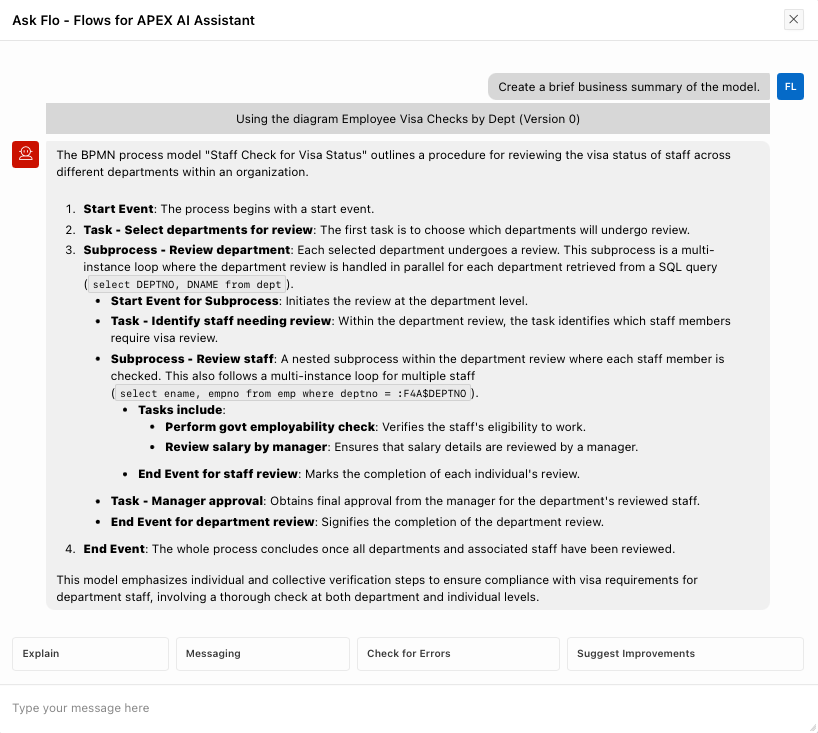
    <p>What can AI do? If I click the ‘Ask Flo’ button, we send a subset of the diagram to the AI service, ask ask for a brief summary of the business process. Here’s the response.</p>

    <p><img src="https://flowquest.net/assets/images/ai-blog-visa-proc-summary.png" alt="Summary of the business process generated by GenAI" title="Employee Check Process - AI Summary" /></p>

    <p>This looks like a good summary of the process. For those who aren’t familiar with the intricacies of BPMN, whether APEX developers new to BPMN or business managers new to process modelling, this should be useful.</p>

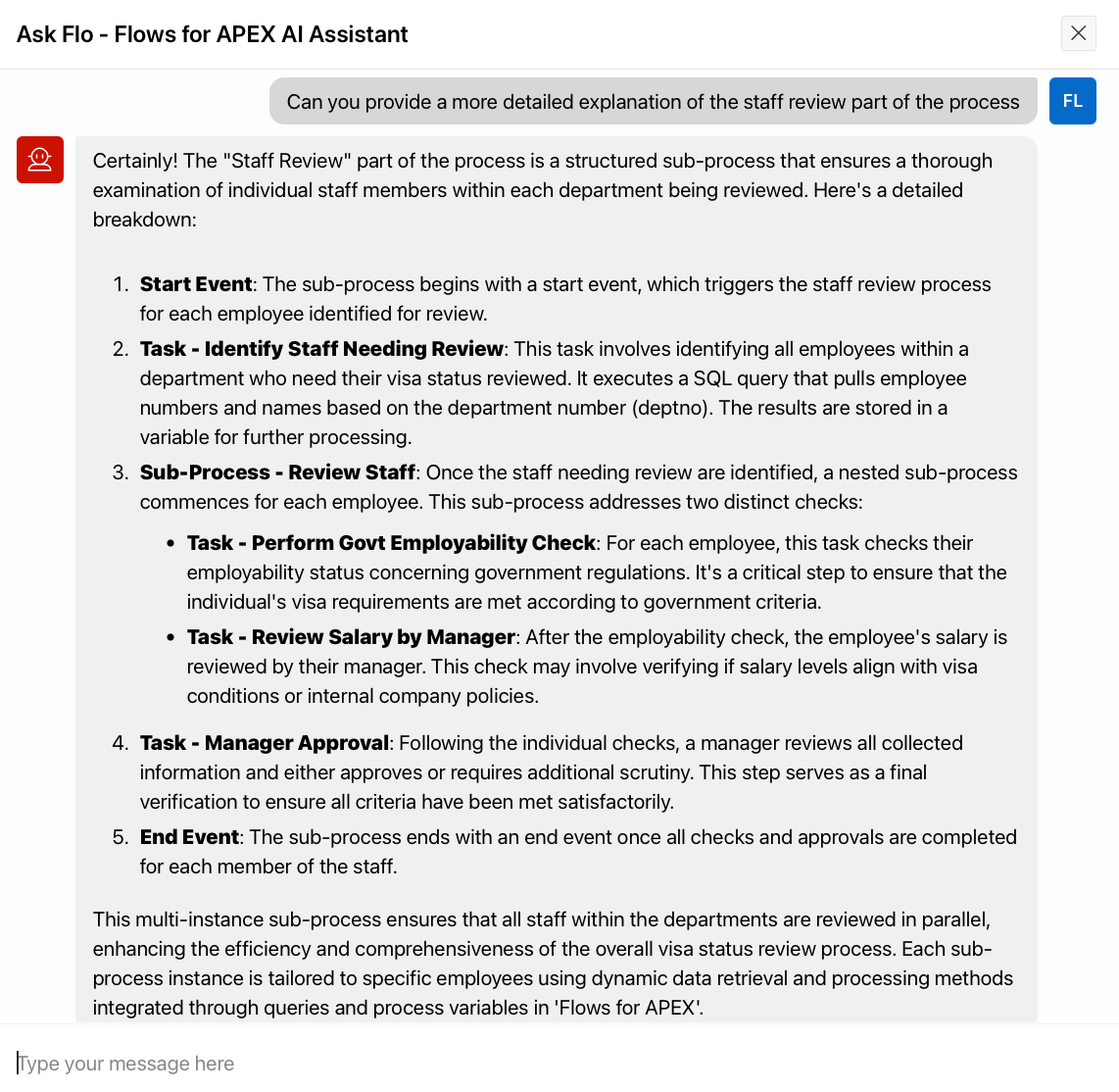
    <p>The AI service is able to answer more detailed questions about the business process or the mechanics of the BPMN diagram. Here is an arbitrary example where we’ve asked for more details on the staff review part of the process using a free text question from the user…</p>

    <p><img src="https://flowquest.net/assets/images/ai-blog-visa-proc-explain.png" alt="Detailed explanation of the staff review sub process" title="Employee Check Process - Explanation" /></p>
  </li>
  <li>
    <h3 id="suggesting-process-model-improvements">Suggesting Process Model Improvements</h3>

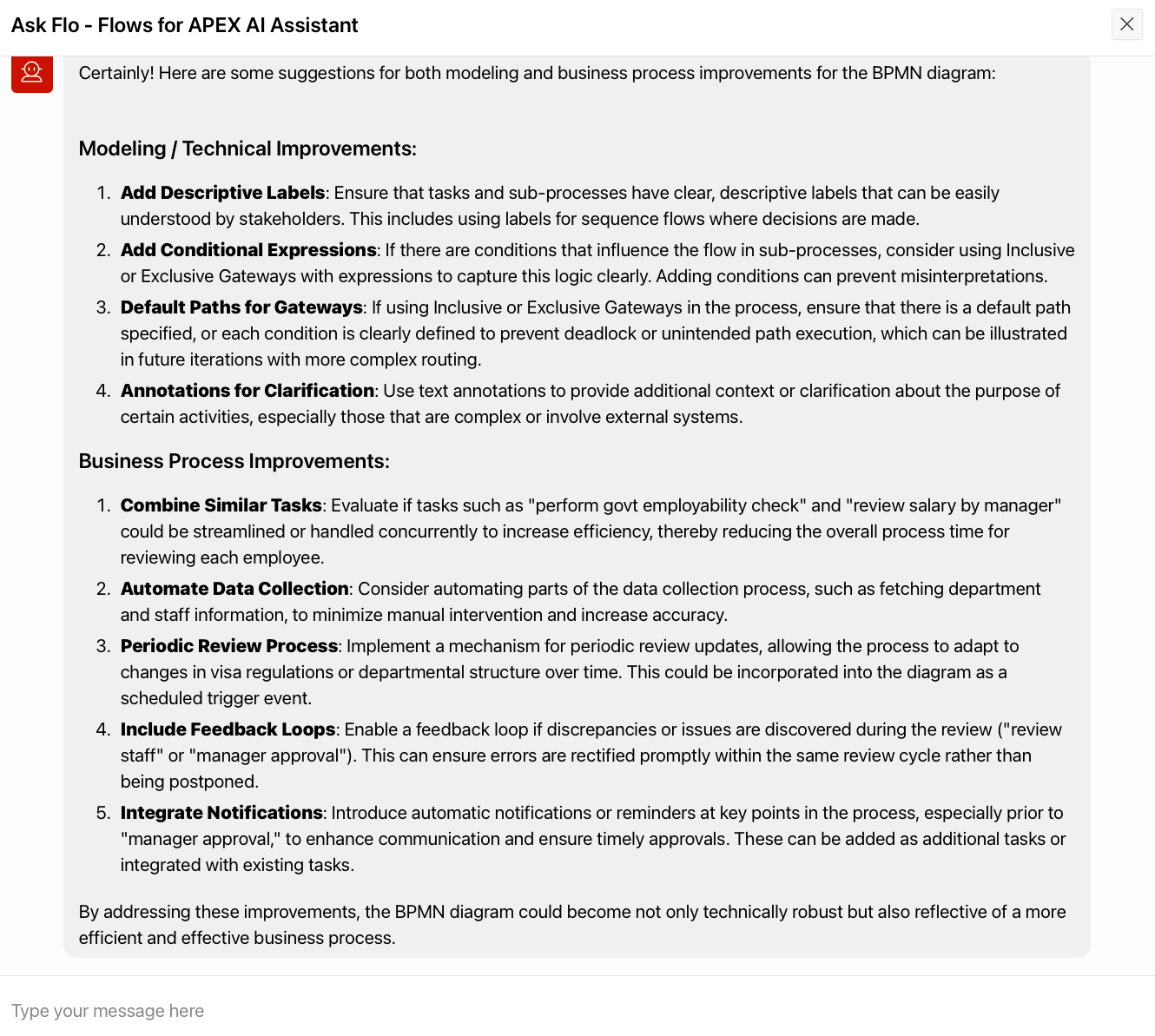
    <p>The next capability that AI can help us with is suggesting improvements to our model, whether these are technical / process modelling improvements or actual business process improvements.</p>

    <p><img src="https://flowquest.net/assets/images/ai-blog-visa-proc-improve.png" alt="suggestions for improvement to our model" title="Employee Check Process - Suggestions" /></p>

    <p>Our experience is that the suggestions provided by AI also range from the simple / trivial to more complex, less obvious ideas. It’s not always easy to get relevant suggestions from simplified demo processes like our staff review process — but you can see that some of the ideas are good and generally helpful.</p>
  </li>
  <li>
    <h3 id="model-error-checking">Model Error Checking</h3>

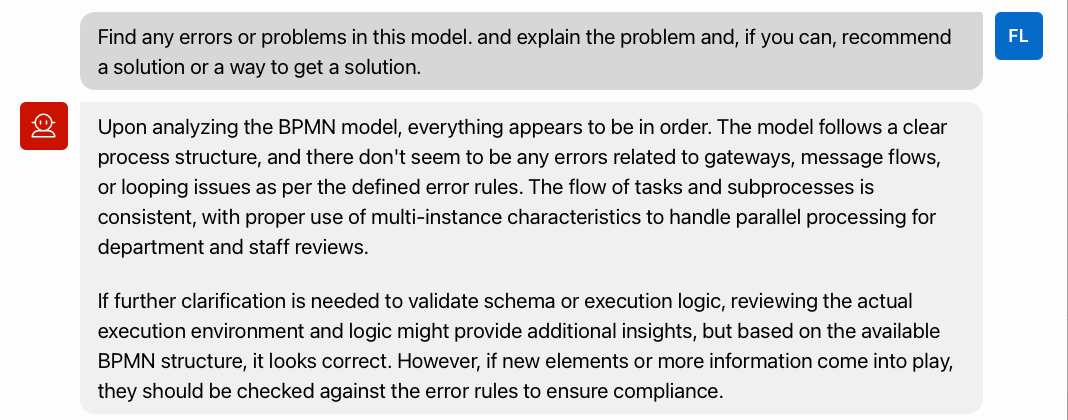
    <p>The next capability is to detect and explain model errors. In the Flows for APEX Process Modeler, we have already included a BPMN linting capability that detects various syntactic errors in your model. Additionally, the AI engine is capable of finding another set of potential errors from its existent knowledge of BPMN and from our training prompt.</p>

    <p>Here’s an error check on our demo model… which appears to be in good order.</p>

    <p><img src="https://flowquest.net/assets/images/ai-blog-visa-proc-error.png" alt="AI output from error checking" title="Employee Check Process - Error Checking" /></p>

    <p>We have a class of typical user errors that come from starting parallel sections in a model, which have to all end at the same merging gateway or go to their own end points. When errors in these. rules occur, our experience is that AI is very good at finding the problem, explaining what the problem is, and suggesting ways to change the model to fix the problem. Certainly better than the typical ‘rule X is broken’ style error message!</p>
  </li>
  <li>
    <h3 id="describing-message-flow">Describing Message Flow</h3>

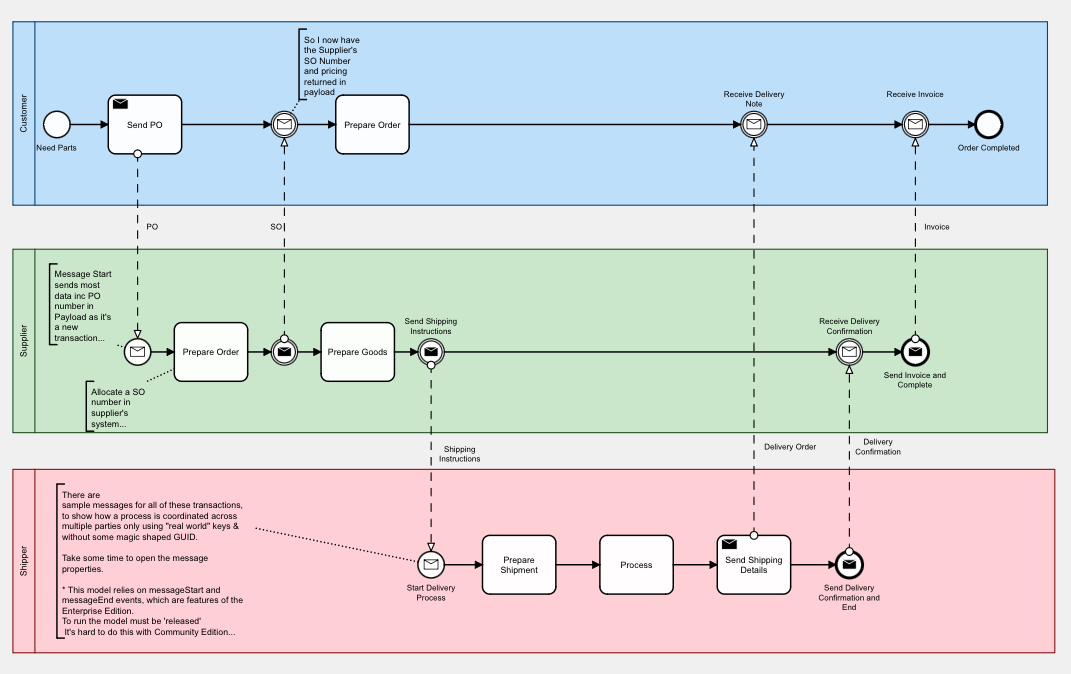
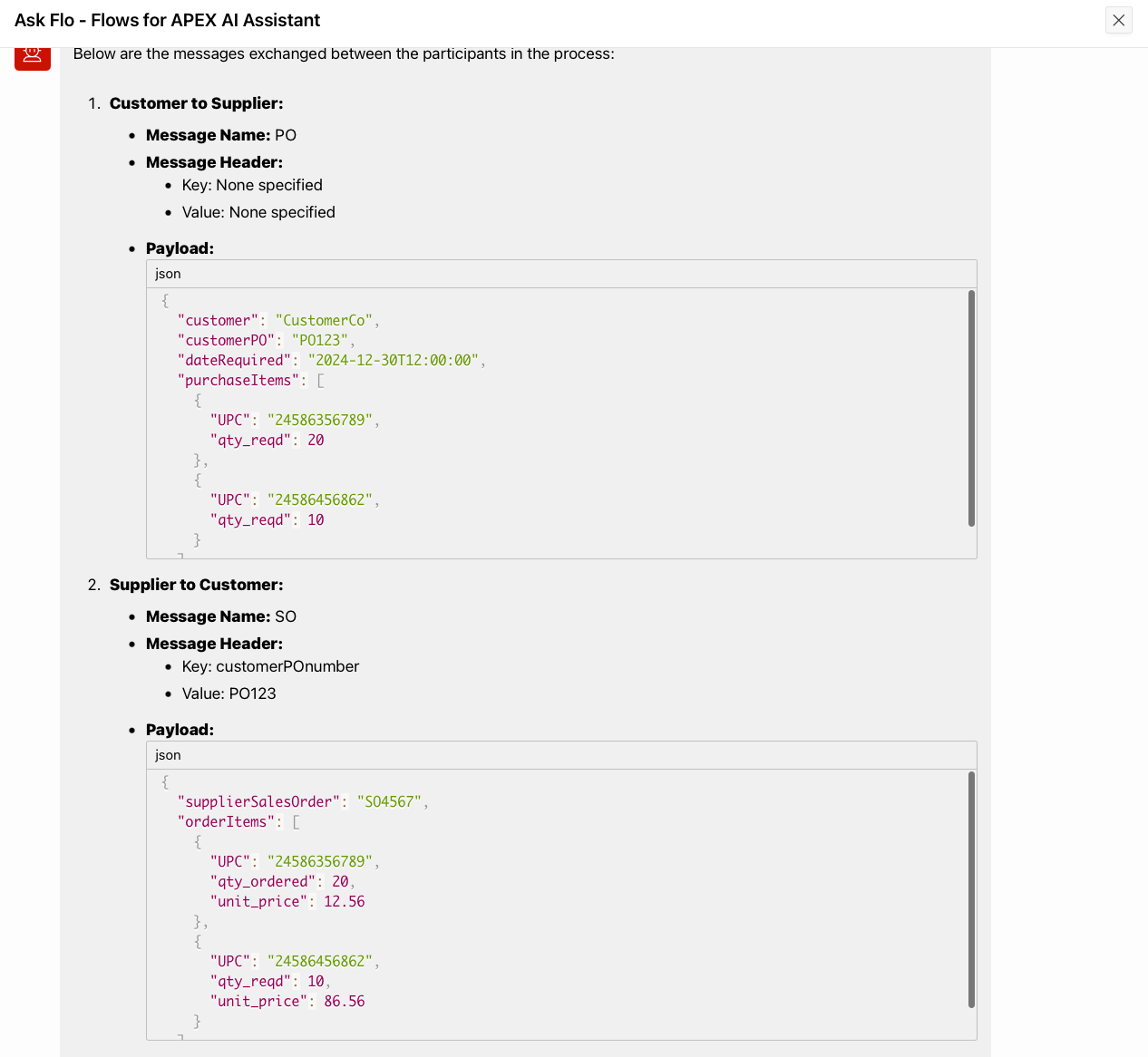
    <p>One of the capabilities of Flows for APEX Enterprise Edition v24.1 is the ability for one process to collaborate with another process, which might be in the same APEX instance or via-REST at a supplier or customer, by sending and receiving messages. This collaboration can start a remote process, subscribe and wait for an incoming message, interrupt a process when a message arrives, or emit a message when a process or sub-process completes. This is process collaboration via BPMN Message Flow.
One of the key design tasks in setting up process collaboration is to design the message definitions to be used in this structured messaging environment. (I’ll write a blog post about this soon). Again AI can help us to describe the messaging defined in a model, pulling information from all of the places where message structure is defined.
Our demo model doesn’t have any messaging in it, so I’ve taken another example here, and given screen shots here of the overall message process and the AI-generated documentation on the message structures.</p>

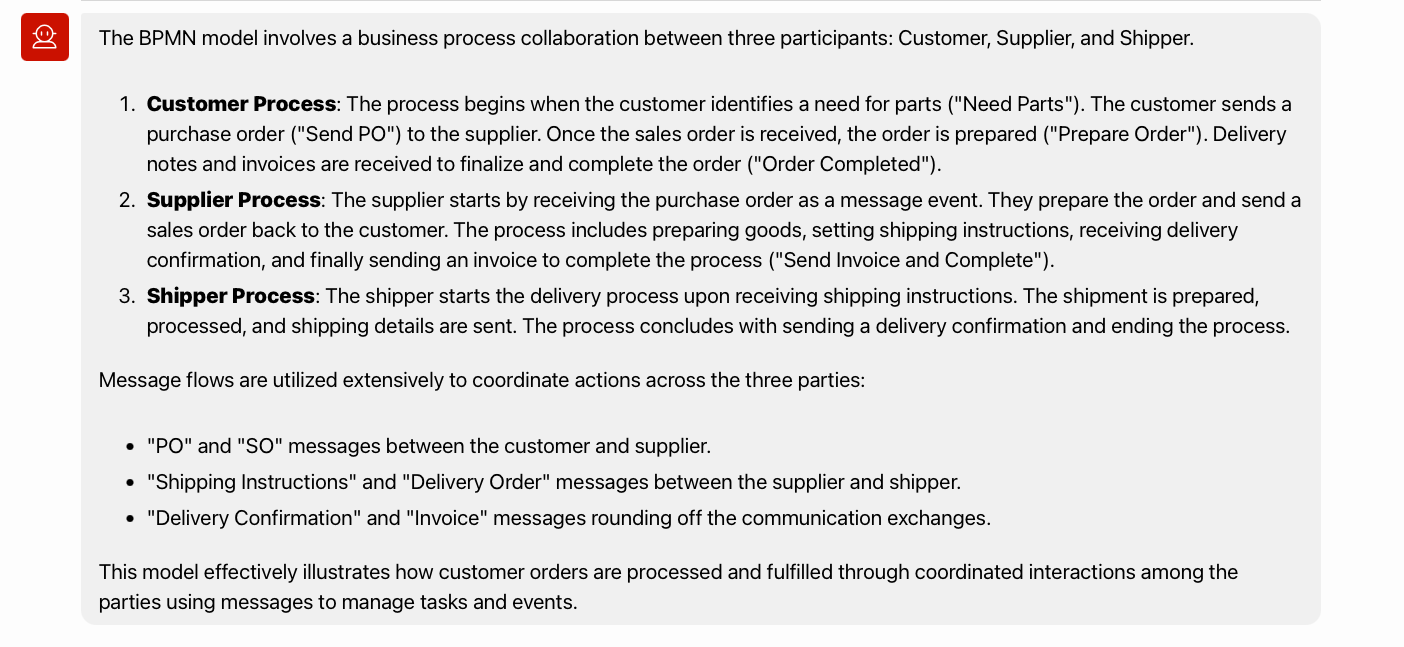
    <p><img src="https://flowquest.net/assets/images/messageflow-241-tutorial7-diagram.png" alt="Supplier - Customer - Shipper process collaboration model" title="Customer - supplier - shipper process diagram" /></p>

    <p>Here’s a summary of the model for those of you not sure about the BPMN here. (it’s easy to generate this, so why not give it to you….)</p>

    <p><img src="https://flowquest.net/assets/images/ai-blog-msgflow-proc-summary.png" alt="Supplier - Customer - Shipper process collaboration summary" title="Customer - supplier - shipper process summary" /></p>

    <p>Asking AI for a description of the message structures gives us this output…</p>

    <p><img src="https://flowquest.net/assets/images/ai-blog-msgflow-proc-msgs.png" alt="Supplier - Customer - Shipper process collaboration summary" title="Customer - supplier - shipper message summary" /></p>
  </li>
  <li>
    <h3 id="language-translation">Language Translation</h3>

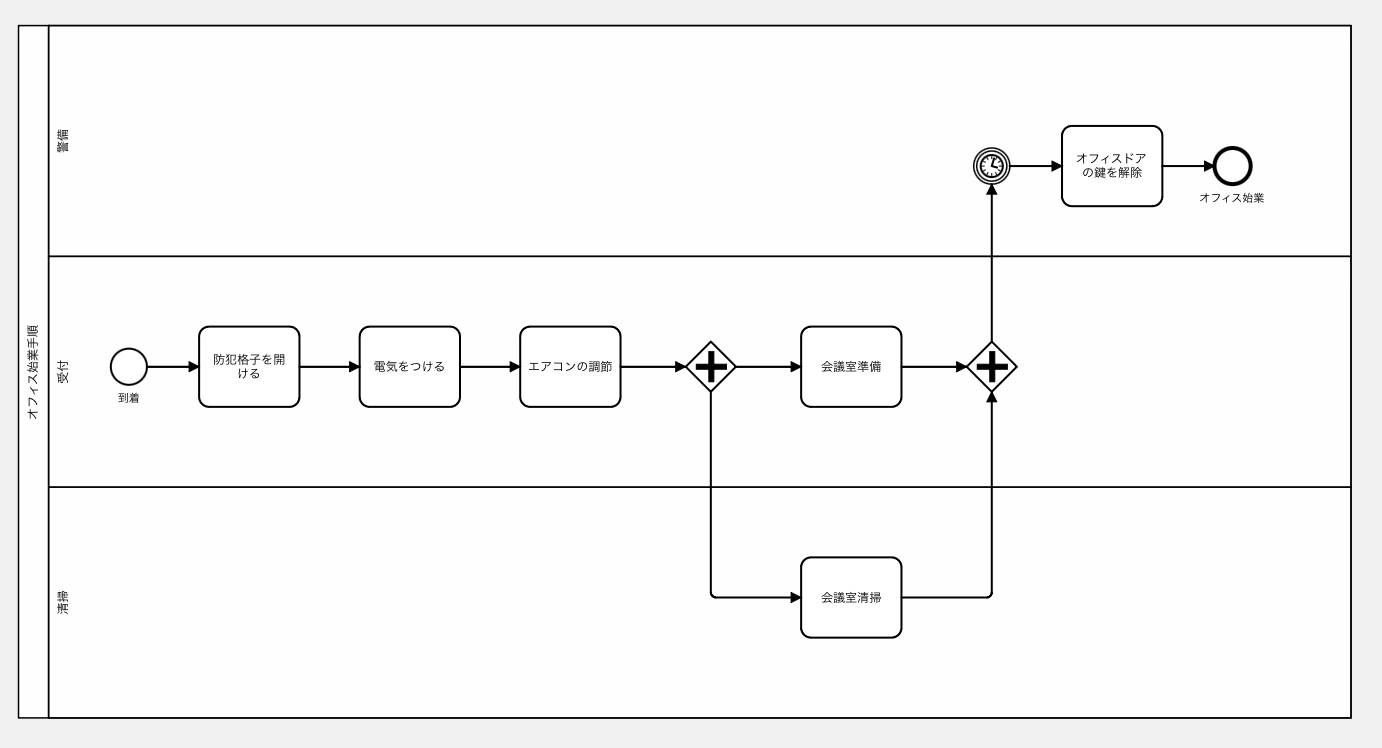
    <p>All of our business process diagrams have been in English so far, but what happens when the diagram is in a language you can’t understand? How can AI help the business manager trying to understand why the business process in the Japanese office isn’t working as they expect? Or how can a support analyst help solve a process problem when it’s 2AM in Tokyo and support has rolled over to the help desk in London?</p>

    <p>Well, the current LLMs are all good at language translation, and we can give AI a model in one language and ask for an explanation in another language.
Here’s a model that most of us can’t read (…with apologies to those of you who can read Japanese!)…</p>

    <p><img src="https://flowquest.net/assets/images/ai-blog-japanese-office-diagram.png" alt="Business process diagram with all text in Japanese." title="Japanese office process - model" /></p>

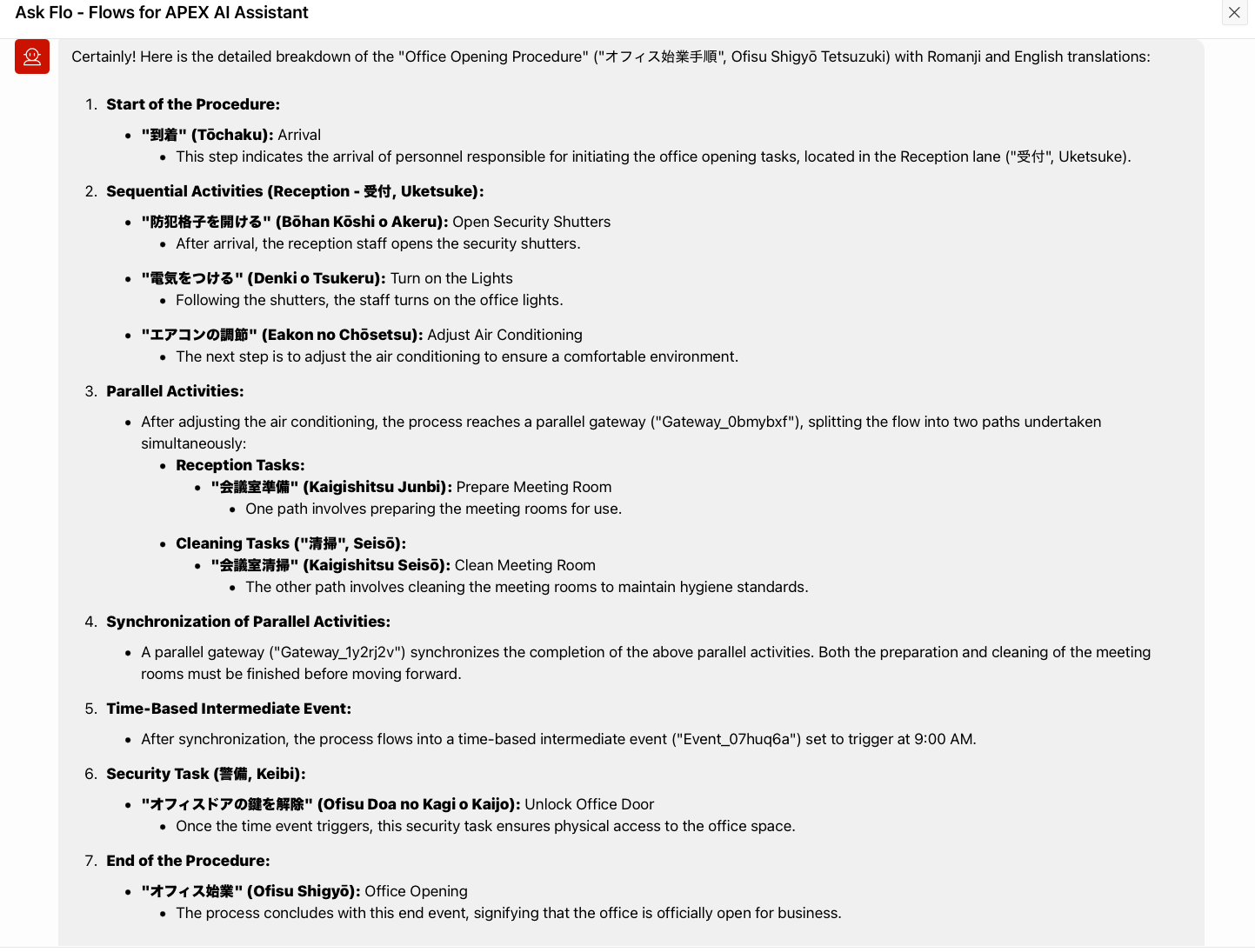
    <p>Where to start? Let’s Ask Flo…</p>

    <p><img src="https://flowquest.net/assets/images/ai-blog-japanese-office-explain.png" alt="Business process diagram explanation in English." title="Japanese office process - model" /></p>

    <p>So now we know what the business process is, and how it works! Note that AI gives us the original task names in Japanese, the pronunciation in Romanji (Japanese using Roman characters), and an English translation.</p>

    <p>This capability works well in all of the languages that we have had native speakers review output.</p>

    <p>Showing off, one of our Flows for APEX users has a requirement to be able to provide output in Welsh language to Welsh users. The AI service can do that** (**to the best of my knowledge, but I can’t read Welsh!)</p>
  </li>
</ol>

<h2 id="ai-services">AI Services</h2>

<p>The results above are all created using the OpenAI <code class="language-plaintext highlighter-rouge">gpt-4o</code> model. Other models, including the Cohere and OCI AI Service models can understand BPMN to a limited degree, but provide output that is much less full and less reliable than these examples. But as with everything AI, the situation is changing rapidly and other models may be capable of producing this quality of interaction soon.</p>

<h2 id="how-do-i-use-this">How Do I Use This?</h2>

<p>The Ask Flo GenAI Assistant is a feature in Flows for APEX Enterprise Edition v24.1, which is now available on a supported, annual subscription basis from Flowquest. (www.flowquest.net).</p>

<p>The Ask Flo AI feature requires APEX 24.1 and a OpenAI API key with pre-paid balance. (Don’t be deterred by the cost of using the AI service - our work to optimise the parts of the BPMN diagram that is sent to BPMN reduces the number of token used, and so the AI running costs of this are not expensive for the benefit provided. My token usage today to create all of the examples in this blog, along with a several other discarded queries, cost under US$0.02).</p>]]></content><author><name>Richard Allen</name></author><category term="AI" /><category term="24.1" /><category term="Enterprise Edition" /><summary type="html"><![CDATA[How we’re using GenAI in Flows for APEX to help model business processes.]]></summary></entry><entry><title type="html">The Future of Flows for APEX</title><link href="https://flowquest.net/posts/F4Afutures/" rel="alternate" type="text/html" title="The Future of Flows for APEX" /><published>2024-10-30T00:00:00+00:00</published><updated>2024-10-29T10:30:00+00:00</updated><id>https://flowquest.net/posts/EErelease</id><content type="html" xml:base="https://flowquest.net/posts/F4Afutures/"><![CDATA[<p>The Future of Flows for APEX</p>

<p>Flows for APEX is a BPMN-based process automation and workflow management system for Oracle APEX, the world’s most popular low-code application platform.  Flows for APEX  enables organizations to model their business processes diagrammatically using the industry standard Business Process Model and Notation (BPMN), then use the power of the Oracle APEX low code development platform to rapidly develop process automation applications.  Flows for APEX provides facilities to execute workflow processes, while providing tools to monitor and manage running workflows.Flows for APEX is an APEX community project that started in 2020, and was initially by Hyand GmbH (formerly MT AG) at ODTUG Kscope 2020.  Subsequent major contributors to the project have come from Hyand, Talan, Oracle Corporation, Solicon, and Flowquest.  Flows for APEX has been downloaded over 10,000 times, and is now in production use at many large organizations, worldwide.</p>

<p>Starting with Flows for APEX version 24.1, Flows for APEX will be available in two editions:</p>

<ul>
  <li>
    <p>Flows for APEX Community Edition.  The Community Edition will remain an Open Source, APEX Community Project.   The software will continue to be available free of charge on an MIT license by download from flowsforapex.org.  Community support available via the project’s GitHub pages.</p>
  </li>
  <li>
    <p>Flows for APEX Enterprise Edition.   The Enterprise Edition is a new offering including major new product features, backed up with technical support, on an annual subscription basis from Flowquest Limited.  Major new features in 24.1 will include support for process collaboration with BPMN Message Flow, process step iteration and looping, and a GenAI assistant in the process modeler.</p>
  </li>
</ul>

<p>The launch of Flows for APEX Enterprise Edition will allow the project to become financially self supporting, and ensure it has the dedicated resources required to support current and future users and for the product to continue to be enhanced with an exciting future development agenda.</p>

<p>Flows for APEX version 24.1 will include exciting new capabilities in both the community and enterprise editions.  Community Edition will include:</p>

<ul>
  <li>APEX Simple Form, enabling an input form page to be specified without having to specify an underlying database table or APEX page by using a flexible JSON region plugin.</li>
  <li>Process Starter.  A pre-built end-user application that enables a user to view the catalog of business processes that they can initiate, pick and start a business process, and shows their current task inbox.  This eases process deployment into the organization.</li>
  <li>JSON-typed Process Variables.
Support for BPMN Color, allowing user-defined coloring of process steps in BPMN diagrams.</li>
</ul>

<p>In addition to these features, the Enterprise Edition will also add the following major features:</p>

<ul>
  <li>BPMN Iteration and Looping.  Workflow steps often need to be executed repeatedly for each item in a list.  Iteration and Looping enables a BPMN task or  sub-process to be repeated once for each item in a list or a query result set, either sequentially or in parallel.  It also allows tasks or sub-processes to be executed continuously in a loop until a complete condition is met.</li>
  <li>
    <p>Process Collaboration with BPMN Message Flow.  Enable processes to message each other, whether on the same APEX instance or to a remote endpoint via REST.  Message Flow allows a process instance to message another process instance, subscribe and wait for an incoming message, start another process instance, interrupt or change the process flow in another instance with message boundary events, or emit a message on completion of a process or sub-process.</p>
  </li>
  <li>AI Assistance to the Process Modeler.  The current set of LLMs understand BPMN, and so are able to summarize, detect and explain model errors, suggest technical, modeling or business process improvements, and explain models built in different languages.  Additional AI use cases and features are planned in later releases.</li>
</ul>

<p>Development of release 24.1 is almost complete, and we are planning to release this imminently, usual caveats notwithstanding.</p>

<p>We are excited about the future of Flows for APEX and to be shipping the next release soon.</p>

<p>Niels De Bruijn						Richard Allen
Hyand GmbH							Flowquest Limited</p>]]></content><author><name>Richard Allen</name></author><category term="Enterprise Edition" /><category term="24.1" /><summary type="html"><![CDATA[The Future of Flows for APEX]]></summary></entry><entry><title type="html">Flows for APEX 24.1 release announcement</title><link href="https://flowquest.net/posts/release24.1/" rel="alternate" type="text/html" title="Flows for APEX 24.1 release announcement" /><published>2024-10-10T00:00:00+00:00</published><updated>2024-10-10T10:30:00+00:00</updated><id>https://flowquest.net/posts/release24.1</id><content type="html" xml:base="https://flowquest.net/posts/release24.1/"><![CDATA[<p>We are excited to introduce <strong>Flows for APEX 24.1</strong>, packed with exciting new features for both the Community and the newly launched <strong>Enterprise Edition</strong>.</p>

<h2 id="key-features-in-241">Key Features in 24.1</h2>

<h3 id="1-developer-free-simple-form-task">1. Developer-Free Simple Form Task</h3>

<p>Empower business users to create simple processes without APEX or database skills. Users can now build process data input forms using JSON-typed variables.</p>

<h3 id="2-introducing-flows-for-apex-enterprise-edition">2. <strong>Introducing Flows for APEX Enterprise Edition</strong></h3>

<p>This new edition offers powerful features, including:</p>

<ul>
  <li>Process collaboration with BPMN Message Flow</li>
  <li>Iterating and looping of process steps</li>
  <li>GenAI support for process modeling with <strong>askFlo</strong></li>
</ul>

<p>Enterprise Edition users also gain access to product support and annual advisory sessions.</p>

<h3 id="3-full-process-collaboration-with-bpmn-message-flow">3. Full Process Collaboration with BPMN Message Flow*</h3>

<p>Enhanced inter-process communication:</p>

<ul>
  <li>Trigger new processes with message events</li>
  <li>Send/receive messages between processes</li>
  <li>Adjust workflows dynamically based on message inputs</li>
</ul>

<h3 id="4-iterating-and-looping-process-steps">4. Iterating and Looping Process Steps*</h3>

<p>Easily repeat tasks for each item in a list, array, or SQL query, either sequentially or in parallel, with full support for BPMN loops.</p>

<h3 id="5-genai-support-with-askflo">5. GenAI Support with askFlo*</h3>

<p>With GenAI assistance, users can:</p>

<ul>
  <li>Explain BPMN models in plain language, even when in a foreign language</li>
  <li>Detect and correct model errors</li>
  <li>Suggest business process improvements</li>
</ul>

<p>GenAI features require Oracle APEX v24.1 or later, Flows for APEX Enterprise Edition, and acess to the OpenAI gpt-4o model via the paid OpenAI API service.</p>

<h3 id="6-process-viewer-enhancements">6. Process Viewer Enhancements</h3>

<p>The enhanced BPMN Process Viewer now allows users to:</p>

<ul>
  <li>Drill into nested iterations</li>
  <li>Highlight model steps with BPMN Color</li>
  <li>Open user tasks directly from the viewer</li>
</ul>

<h2 id="community-edition-still-open-source">Community Edition: Still Open Source!</h2>

<p>The <strong>Flows for APEX Community Edition</strong> remains 100% open source under the MIT license, with community support via GitHub.</p>

<p>Explore the full details of version 24.1 and start transforming your workflows today!</p>

<p><em>Some features marked with an asterisk (*) are exclusive to the Enterprise Edition.</em></p>

<p><a href="https://flowsforapex.org/Flows4APEX241Features/">Learn more about the release</a></p>]]></content><author><name>Louis Moreaux</name></author><category term="Announcement" /><category term="24.1" /><summary type="html"><![CDATA[We are excited to introduce Flows for APEX 24.1, packed with exciting new features for both the Community and the newly launched Enterprise Edition.]]></summary></entry><entry><title type="html">Flows for APEX 23.1 release announcement</title><link href="https://flowquest.net/posts/release23.1/" rel="alternate" type="text/html" title="Flows for APEX 23.1 release announcement" /><published>2023-08-10T00:00:00+00:00</published><updated>2023-08-10T13:30:00+00:00</updated><id>https://flowquest.net/posts/release23.1</id><content type="html" xml:base="https://flowquest.net/posts/release23.1/"><![CDATA[<p>Flows for APEX 23.1 is now available for download at <a href="https://flowsforapex.org">flowsforapex.org</a>.</p>

<p>This release includes several exciting new features that are described in the paragraphs below.</p>

<h2 id="task-assignment-due-dates-and-priorities">Task Assignment, Due Dates and Priorities</h2>
<p>With this release, we cover the missing part that was assignment, due dates and priorities. Not that it was not possible to handle it before by using lanes and some process variables but it is now much more easier.</p>

<p>Starting from version 23.1, in the modeler for User Task, you can now define:</p>
<ul>
  <li>The potential Users</li>
  <li>The potential Groups</li>
  <li>The excluded Users</li>
  <li>The priority</li>
  <li>The due date</li>
</ul>

<p>Like variable expressions, these attributes can be defined using</p>
<ul>
  <li>A static value</li>
  <li>A variable expression</li>
  <li>A SQL query (returning a single value or a colon delimited list)</li>
  <li>A PL/SQL expression or function body</li>
</ul>

<p><img src="https://flowquest.net/assets/images/231_blog_task_assignment.png" alt="Task assignment, due date and priority in the process modeler" title="Task assignment, due date and priority in the process modeler" class="align-center" /></p>

<h2 id="bpmn-message-flow">BPMN Message Flow</h2>
<p>With this release, we started the implementation of inter process communication through messages by implementing the following BPMN objects:</p>
<ul>
  <li>Send and Receive Tasks</li>
  <li>Message Catch and Throw Events</li>
</ul>

<p>Your process can now send messages to the outside world but also wait for an incoming message. Combined with the new REST API, this feature offers the ability for external applications to send a message and a payload that can be then used in your process!</p>

<h2 id="rest-api">REST API</h2>
<p>That feature was probably one of the most asked by our customers, the Flows for APEX PL/SQL API is now REST-enabled so you can remotely execute all the API calls.</p>

<p><img src="https://flowquest.net/assets/images/231_blog_rest.png" alt="Swagger API doc" title="Swagger API doc" class="align-center" /></p>

<p>We also provide, in the engine app, a configuration page to create REST clients and assign them their roles based on the API call you want to allow.</p>

<p>We hope that this feature will make the integration of Flows for APEX with third-party system way more easier than before, we can’t wait to see what you will build with it!</p>

<h2 id="major-upgrade-to-graphical-workflow-modeler-and-viewer">Major Upgrade to Graphical Workflow Modeler and Viewer</h2>
<p>The <a href="https://bpmn.io/">bpmn.io</a> library has been updated to the latest version in our APEX plug-ins (modeler and viewer). The result is:</p>
<ul>
  <li>a much more modern properties panel</li>
  <li>an easier use of controls</li>
  <li>a better keyboard navigation</li>
  <li>a new capability to drill-down into collapsed SubProcesses and Call Activity (viewer only)</li>
  <li>a new support of BPMN Groups, Child Lanesets and Annotations</li>
</ul>

<p>We hope that this release will make process designers really happy.</p>

<h2 id="developer-experience-enhancements">Developer Experience Enhancements</h2>
<p>With this release, we also wanted to address a few things that we think APEX developers using Flows for APEX will find useful like:</p>
<ul>
  <li>the introduction of a new process variable type: Timestamp with Time Zone</li>
  <li>the support of process variable binding has been extended to SQL and PL/SQL everywhere</li>
  <li>a better integration with APEX Approval Task and Unified Task List</li>
  <li>the support of APEX automation for the Manage Flow Instance plug-in. One of the possible use cases is starting a flow instance from an APEX automation declaratively!</li>
</ul>

<h2 id="logging-archiving-and-process-statistics-improvements">Logging, Archiving, and Process Statistics improvements</h2>
<p>This release brings a lot of improvements for Process Administrators. Firstly, we implemented the process model and diagram changes logging. With this feature, we think that we fully cover the logging needs.</p>

<p>We also introduce a new Process Timeline page in the engine app, accessible through the action menu of the flow instance detail page. It will basically display, in a nice format, everything that happens to an instance.</p>

<p>We leverage the APEX automation power to create Instance Summary Archive and automated purging of the logs. Everything can be configured on the configuration pages.</p>

<p>Finally we started to implement process statistics by generating process and tasks statistics that include processing and waiting times. We do encourage you to turn on the statistics on your system to start gathering data about your processes!</p>

<h2 id="more-languages-supported">More Languages Supported</h2>
<p>Four new languages are now supported in Flows for APEX by the introduction of:</p>
<ul>
  <li>Italian</li>
  <li>Korean</li>
  <li>Simplified Chinese</li>
  <li>Traditional Chinese</li>
</ul>

<p>Flows for APEX is now supporting all of the 10 languages that the APEX Application Builder supports.</p>

<p><img src="https://flowquest.net/assets/images/231_blog_languages.PNG" alt="Flows for APEX langugage support" title="Flows for APEX langugage support" class="align-center" /></p>]]></content><author><name>Louis Moreaux</name></author><category term="Announcement" /><category term="23.1" /><summary type="html"><![CDATA[Flows for APEX 23.1 is now available for download at flowsforapex.org.]]></summary></entry><entry><title type="html">Flows for APEX 22.2 release announcement</title><link href="https://flowquest.net/posts/release22.2/" rel="alternate" type="text/html" title="Flows for APEX 22.2 release announcement" /><published>2022-10-11T00:00:00+00:00</published><updated>2022-10-11T12:00:00+00:00</updated><id>https://flowquest.net/posts/release22.2</id><content type="html" xml:base="https://flowquest.net/posts/release22.2/"><![CDATA[<p>Flows for APEX 22.2 is now available for download at <a href="https://flowsforapex.org">flowsforapex.org</a>. This major release has a lot of new functionality to offer, including:</p>
<ul>
  <li>Support for Call Activities in BPMN 2.0</li>
  <li>Gateway Path Expressions</li>
  <li>Integration with the Approval Task Component in APEX 22.1+</li>
  <li>Language support for Japanese, Portuguese, Spanish and German</li>
</ul>

<p>Richard Allen demonstrated key features of 22.2 in the APEX Office Hours session of 29-SEP. For those of you that missed that session, you can watch a replay <a href="https://www.youtube.com/watch?v=NlbRRvK9QjI">here</a>.</p>

<p>Minimum requirements for installation are Oracle DB 19c+ and Oracle APEX 20.1+. For a quick start, I suggest to install it in a free workspace on <a href="https://apex.oracle.com">https://apex.oracle.com</a>.</p>

<p>We have also updated the sample app “Expense Claims” that ships with the software distribution to reflect most of the new features in 22.2.
If you are new to BPMN 2.0, I recommend looking at the preinstalled tutorials in the Flows for APEX app.</p>

<p>Ready to start building your first process-oriented app based on Flows for APEX 22.2? Have a look at our updated step-by-step tutorial on the start page of <a href="https://flowsforapex.org">flowsforapex.org</a>.</p>]]></content><author><name>Niels de Bruijn</name></author><category term="Announcement" /><category term="22.2" /><summary type="html"><![CDATA[Flows for APEX 22.2 is now available for download at flowsforapex.org. This major release has a lot of new functionality to offer, including: Support for Call Activities in BPMN 2.0 Gateway Path Expressions Integration with the Approval Task Component in APEX 22.1+ Language support for Japanese, Portuguese, Spanish and German]]></summary></entry><entry><title type="html">Flows for APEX 21.1: what’s new</title><link href="https://flowquest.net/posts/release21.1/" rel="alternate" type="text/html" title="Flows for APEX 21.1: what’s new" /><published>2021-09-30T00:00:00+00:00</published><updated>2021-09-28T12:00:00+00:00</updated><id>https://flowquest.net/posts/release21.1</id><content type="html" xml:base="https://flowquest.net/posts/release21.1/"><![CDATA[<p>Flows for APEX is an extension for Oracle Application Express (APEX) that lets you model and run processes based on the BPMN 2.0 standard. This blog article will address some of the key features introduced with version 21.1.</p>

<h4 id="setting-process-variables-before-andor-after-each-step">Setting process variables before and/or after each step</h4>
<p><img src="https://flowquest.net/assets/images/varExpression.apng" alt="image-center" class="align-center" /></p>

<p>With the help of process variables, information can be stored persistently in the database over the entire duration of a process instance. You can set a process variable through the PL/SQL API or, with 21.1, do this declarative for each step in the BPMN model. The variables are meant to be set at special trigger points in the model (e.g., after a task has been executed or before the process is split up at a gateway) and read out again at a later point in time without the need of an APEX session.</p>

<h4 id="restart-failed-tasks">Restart failed tasks</h4>
<p><img src="https://flowquest.net/assets/images/errorHandling.apng" alt="image-center" class="align-center" /></p>

<p>Sometimes the execution of a step in a process fails, so that the process cannot continue. In this case, the transaction of the current step is rolled back, and the instance is set to an error state. With the help of the previously mentioned auditing capabilities, the error can be located and fixed. To restart the step, either execute the PL/SQL procedure flow_api_pkg.flow_restart_step or press the corresponding button on the Flow Monitor page.</p>

<h4 id="more-engine-app-enhancements">More engine app enhancements</h4>
<p><img src="https://flowquest.net/assets/images/keyboardShortcuts.apng" alt="image-center" class="align-center" /></p>

<p>The Flows for APEX engine app is used to manage the BPMN models and process instances. With version 21.1, several enhancements have been made:</p>
<ul>
  <li>Use of keyboard shortcuts in the modeler (copy, paste, save)</li>
  <li>Support for dark mode</li>
  <li>Layout adjustments to support different screen sizes</li>
  <li>Bulk export/import of models</li>
  <li>Export of a model or an instance as SVG</li>
</ul>

<h4 id="process-plug-ins-for-a-true-low-code-experience">Process plug-ins for a true low-code experience</h4>

<p>Next to the existing region plug-in “Flows for APEX viewer” for displaying BPMN models, 3 process plug-ins were introduced that can be used in your own APEX application to manage a flow instance without the need of custom coding:</p>

<ol>
  <li>Management of the entire flow instance (start, stop, terminate, reset, delete)</li>
  <li>Management of a single step within the flow instance (start, reserve, release, complete)</li>
  <li>Management of process variables of a flow instance (setting / reading out the variables in conjunction with APEX page items)</li>
</ol>

<p>The plugins are included in the distribution of the Flows for APEX application and can be easily exported and imported to be used in own applications.</p>

<h4 id="auditing">Auditing</h4>

<p>During the execution of a process flow, information is written to a logging table at various points in Flows for APEX. This includes events occurring at instance level as well as task-level together with a timestamp and the calling user. These can be called upon in the engine app via the detail page of a process instance for management and debugging purposes. Furthermore, logging information for a specific step in the instance can be displayed by simply clicking on it in the Flows for APEX Viewer.</p>

<h4 id="sample-app-expense-claims">Sample app “Expense Claims”</h4>

<p>To demonstrate the integration of Flows for APEX in an APEX application, a new demo application comes with the distribution of Flows for APEX 21.1. This application covers a simple expense claim process and helps APEX developers to understand how to develop process-driven applications.</p>]]></content><author><name>Niels de Bruijn</name></author><category term="Announcement" /><category term="21.1" /><summary type="html"><![CDATA[Flows for APEX is an extension for Oracle Application Express (APEX) that lets you model and run processes based on the BPMN 2.0 standard. This blog article will address some of the key features introduced with version 21.1.]]></summary></entry></feed>